Adding poured rubber to your contracting business: what you need
Quick answer
A contractor adding poured rubber needs five things: EPDM granules and binders, a forced-action mixer, spare buckets so the mixer is never waiting, trowel cleaner to keep tools clean, and training in mix ratios, curing and finishing. Resin Rubber sells the materials and equipment directly to contractors and does not install.
Key takeaways
- The kit is granules, binders, a forced-action mixer, spare buckets and trowel cleaner.
- A second set of buckets lets the crew weigh out the next batch while the current one mixes.
- Training covers mix ratios, working times and curing before you take on jobs; it does not make a system suitable for a given site.
- Contractors can buy materials directly. Resin Rubber supplies and does not install.
To add poured rubber to what you quote, you need EPDM granules and binder, a forced-action mixer, spare mixing buckets, trowel cleaner and someone on the crew who has learned the process. Resin Rubber supplies all of those materials and equipment to contractors. It does not install surfaces.
This is a checklist, not a business plan. It leaves out prices on purpose. Trade pricing is available to approved customers who log in.
1. Granules
EPDM rubber granules come in 55 lb bags, and the Contractor Edition says they use recycled rubber content. The range is 28 solid colors and 12 pre-mixed blends. Blend recipes are published by color code and percentage, so a blend can be reordered to match later. Browse the solid colors and mixed color blends, and ask customers to choose against a physical sample, because screens do not show granule color accurately.
2. Binder
Two binders come in 5-gallon pails:
| Binder | Use |
|---|---|
| Aliphatic | UV stable. Does not yellow in sun. Exposed wearing course and top layers |
| Aromatic | Lower cost. Base layers and layers covered by another material |
Many projects use both. Binders are not interchangeable by name alone, so confirm the role, compatibility and quantity for each job with the materials team, and read the current technical and safety data sheets. More in aliphatic vs aromatic binder and the binder collection.
3. A forced-action mixer
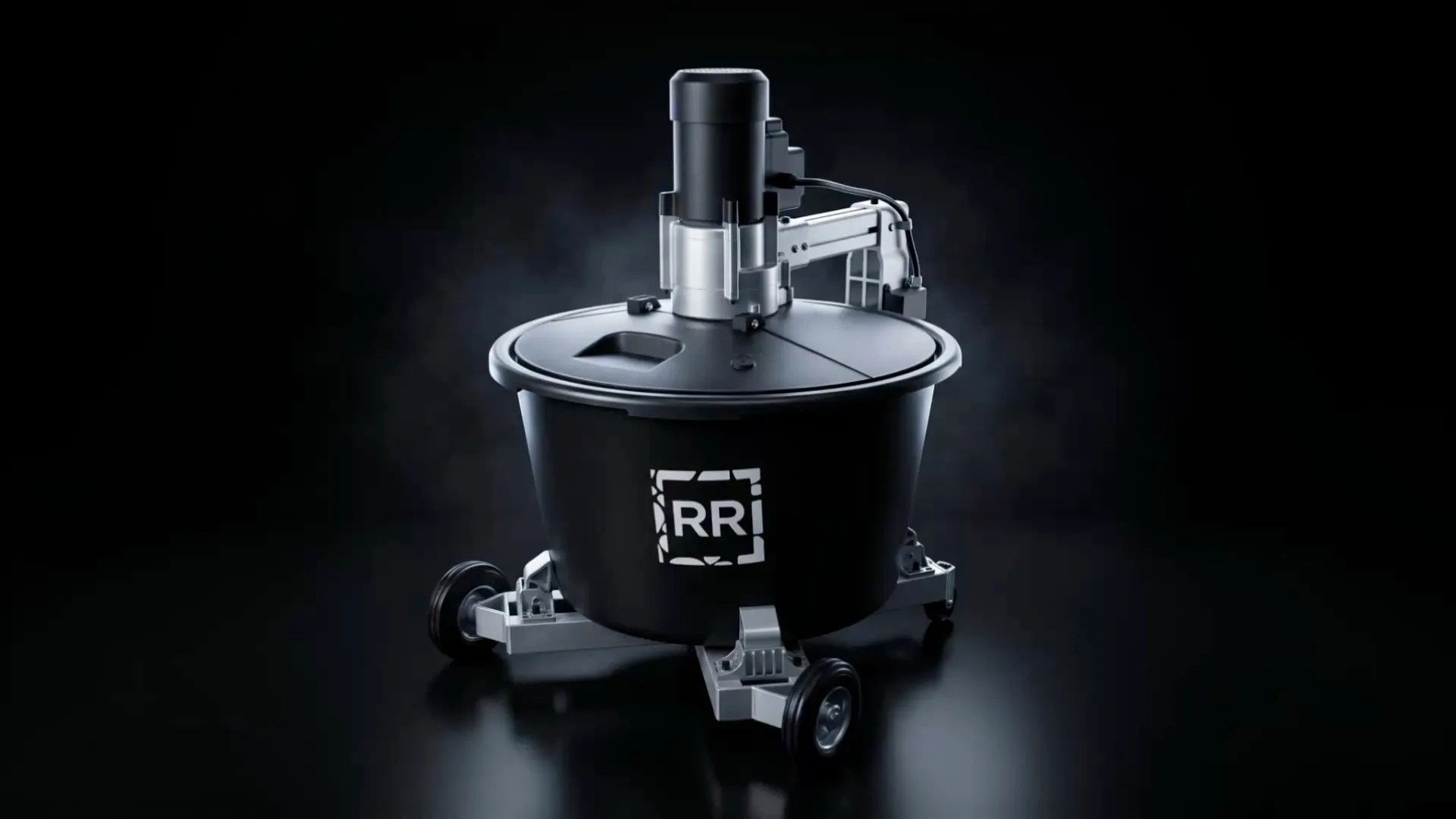
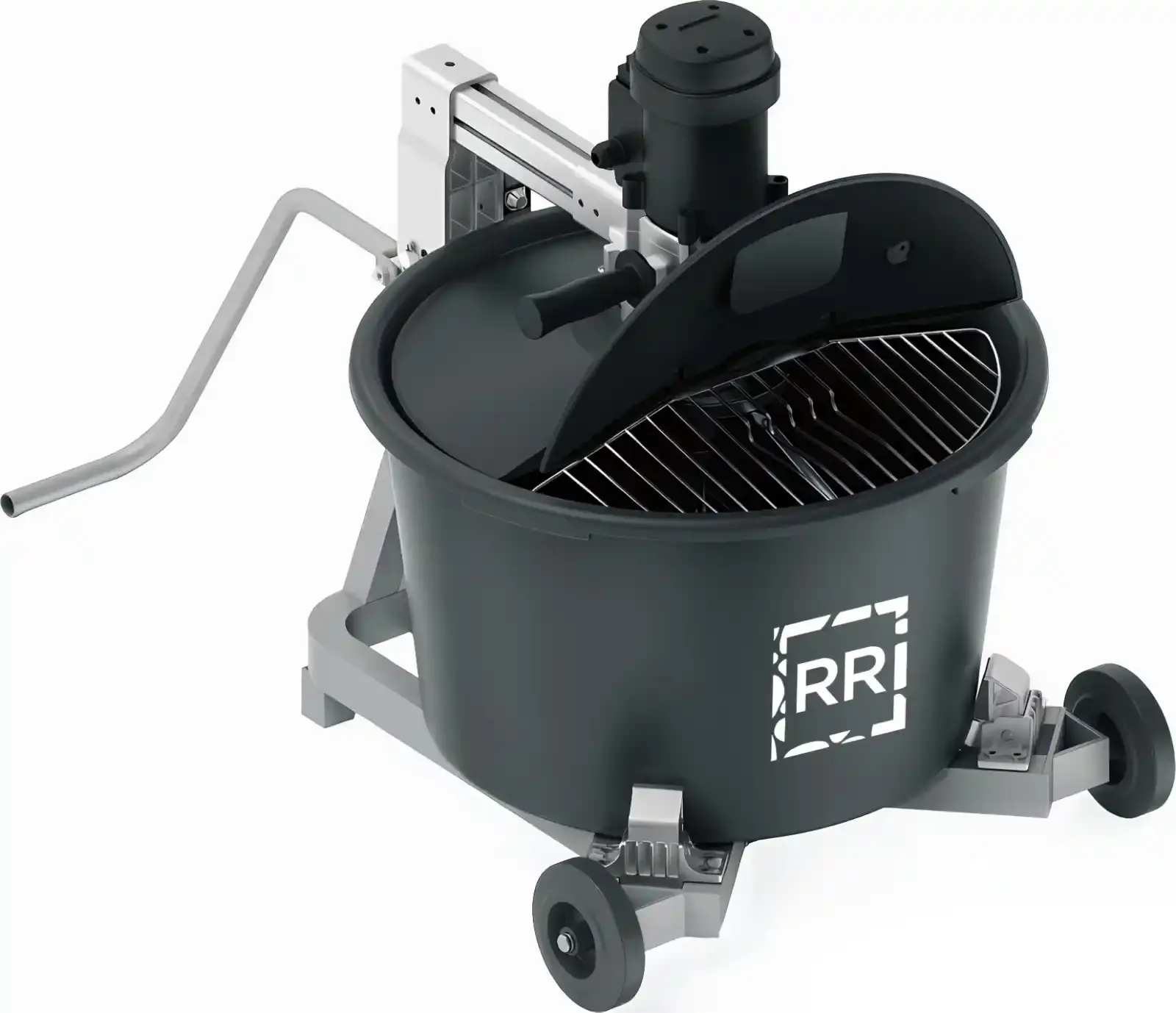
The RR80L is rated 230V / 50Hz at 1400 W, with a brushless motor and a 55 L working capacity (65 L bucket). It comes with a guard-open interlock, automatic overload cut-off and a 2-year warranty on parts and motor. Check that the 230V / 50Hz supply matches the power you will have on site. Operating range is 30°F to 105°F, and the mixer is IPX4 splash-resistant. The warranty covers the motor, gearbox and drive, safety cut-off and chassis, and does not cover wear parts such as paddle blades, seals and wheels, or operator misuse. To claim, register the unit within 30 days. The standard EPDM batch is 36 L of granules to 4 L of binder (9:1 by volume), mixed for 3 minutes from the moment the binder goes in. The full method is in mixing EPDM granules and binder. See the rubber mixer.
Note that 30°F to 105°F is the mixer’s operating range. It is not a temperature limit for pouring. Binder temperature limits come from the data sheets.
4. Spare buckets and parts
A set of four black buckets fits the RR80L. With them, the crew can weigh out the next batch of granules and binder while the current one mixes, then swap it in, so the mixer is not waiting between batches. The buckets clamp into the frame the same way as the one that comes with the mixer. Ask the materials team if you are not sure your mixer takes them. See rubber buckets.
The bucket is the hardest-worked part of a forced-action mixer, because grit, aggregate and repeated cycles wear it. The replacement bucket (RR80B) is heavy-duty HDPE and swaps in with the standard clamp release. The brochure suggests inspecting it quarterly for cracks, rim wear or chemical scoring, and gives a typical service life of 12 to 36 months depending on daily volume, aggregate type and how well it is cleaned. Other spares listed are the guard and interlock, tilt handle, paddle, braked wheel set and clamp latches. Order through your dealer or the parts page.
5. Trowel cleaner
Cured binder on a trowel drags through the next mix and leaves marks in the finish. A cleaning compound that dissolves cured resin from trowels, lutes and mixer paddles keeps each batch going on clean. It comes in three sizes: an 11 lb container for smaller crews and occasional jobs, 3.5 gallons for crews installing most weeks, and 5 gallons for back-to-back jobs. See trowel cleaner.
Keep petroleum-based cleaners and unapproved solvents out of the mixer.
6. Training
Training teaches the process before you are on a customer’s site. Bronze is for 2 people and covers EPDM granules, binders and color options, mix ratios, working times and curing, hands-on installation, troweling and finishing, and basic repairs. Silver is for 4 people and adds advanced preparation and base repair, multi-color designs, fall height and ADA, estimating and sales. Both include a certificate. Details are in what installer training covers and on the training page.
Training does not make a system suitable for a particular site. The base and the specification still decide that.
7. What you still bring
Resin Rubber supplies materials and equipment. You supply the crew, the truck, the site assessment and the installation.
Where to start
Read the installation guide for the standard sequence, ask the materials team for the data sheets for the system you plan to use, and decide whether a trade account or the dealer program suits the volume you expect.
Frequently asked questions
Do I need training before I buy materials?
No. Contractors can buy materials directly. Training is a way to learn mix ratios, working times, curing, troweling and finishing before taking on jobs.
Can I use any mixer?
The RR80L forced-action mixer is the mixer the Resin Rubber system is specified around. Its paddles force the granules through the binder so every granule is evenly coated. Ask the materials team before using a different mixer.
Where do I get the data sheets?
Ask the materials team for the current technical and safety data sheets for the products you plan to use, and read them before the first job.
Is there a dealer route as well?
Yes. Contractors placing repeat orders can open a trade account, and the dealer program covers territory, leads and launch support. Look at the dealer program for details.